

Search Knowledge Base by Keyword
-
Introduction
-
Fundamentals
-
My ReadyWorks
-
Analytics
-
-
-
- Available Reports
- All Data Types
- Application Certification Status
- Application Discovery
- Application Group Analysis
- App Group to SCCM Collection Analysis
- Application Install Count
- Application License Management
- Application Usage
- Assets by Values
- Build Sheet
- Computer User Assignment
- Data Type Column Mappings
- Delegate Relationships
- ETL5 Staging Data
- Migration Readiness (Basic)
- Migration Readiness (Complex)
- O365 License Management
- O365 Migration Readiness
- Patch Summary
- Record Count by Property
- SCCM OSD Status
- Scheduled Computers by Wave
- Scheduled Users by Manager
- User Migration Readiness
- VIP Users
- Wave & Task Details
- Wave Group
- Windows 10 Applications
- Show all articles ( 14 ) Collapse Articles
-
-
-
-
Orchestration
-
Data
-
-
- View Primary Data
- Record Properties
- Images
- Notes
- Waves
- Tasks
- Attachments
- History
- Rationalization
- QR Code
- Linked Records
- SCCM Add/Remove Programs
- Altiris Add/Remove Programs
- Related Records
- Advanced Search
- Relationship Chart
- Primary Data Permissions
- Show all articles ( 2 ) Collapse Articles
-
Integration
-
-
-
- View Connection
- Connection Properties
- Make Into Connector
- Delete Connection
- Connection Error Settings
- Inbound Jobs
- Outbound Jobs
- New Inbound Job
- New Outbound Job
- Job Error Settings
- Enable Job
- Disable Job
- Edit Inbound Job
- Edit Outbound Job
- Upload File
- Run Inbound Job
- Run Outbound Job
- Set Runtime to Now
- Reset Job
- Delete Job
- Job Log
- Show all articles ( 6 ) Collapse Articles
-
-
- View Connector
- Connector Properties
- Authentication Methods
- New Authentication Method
- Authentication Method Error Settings
- Edit Authentication Method
- Delete Authentication Method
- Fields
- Edit Field
- Inbound Job Fields
- Edit Inbound Job Field
- Inbound Job Templates
- New Inbound Job Template
- Job Template Error Settings
- Edit Inbound Job Template
- Delete Inbound Job Template
- Outbound Job Fields
- Edit Outbound Job Field
- Outbound Job Templates
- New Outbound Job Template
- Edit Outbound Job Template
- Delete Outbound Job Template
- Show all articles ( 7 ) Collapse Articles
-
-
- ETL5 Connector Info
- Absolute
- Azure Active Directory
- Comma-Separated Values (CSV) File
- Generic Rest JSON API
- Generic Rest XML API
- Ivanti (Landesk)
- JAMF
- JSON Data (JSON) File
- MariaDB
- Microsoft Endpoint Manager: Configuration Manager
- Microsoft SQL
- Microsoft Intune
- Oracle MySQL
- PostgreSQL
- Pure Storage
- ServiceNow
- Tanium
- XML Data (XML) File
- JetPatch
- Lenovo XCLarity
- Nutanix Move
- Nutanix Prism
- Nutanix Prism - Legacy
- RVTools
- Simple Object Access Protocol (SOAP)
- VMware vCenter
- VMware vCenter SOAP
- Show all articles ( 13 ) Collapse Articles
-
-
Admin
-
-
-
- Modules
- Attachments
- Bulk Edit
- Data Generator
- Data Mapping
- Data Quality
- ETL
- Form Builder
- Images
- Multi-Factor Authentication
- Notifications
- Rationalization
- Relationship Chart
- Reports
- Rules
- Single Sign-On
- T-Comm
- User Experience
- Show all articles ( 4 ) Collapse Articles
-
-
API
-
Administration
-
FAQs
-
Solutions
-
Accelerator – VM Classification
The Accelerator – VM Classification report provides a summary of virtual machine classifications across your environment. Use this report to understand how workloads are distributed between Virtual Desktop Infrastructure (VDI) and Corporate (Corp) virtual machines, helping you assess workload composition and estimate resource requirements for migration planning.
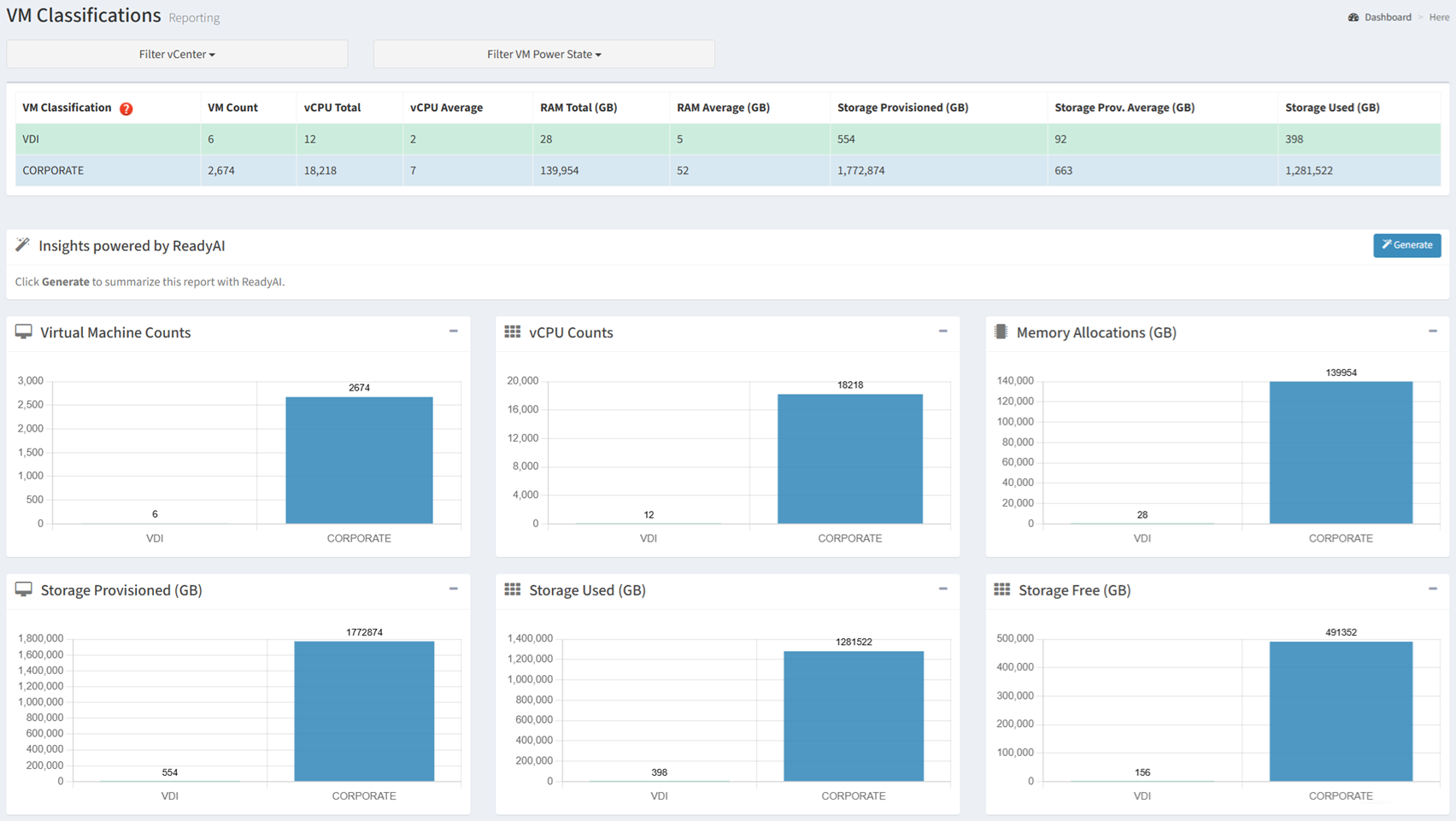
Available operations:
- View the distribution of virtual machines by classification (VDI and Corporate)
- Filter the report by vCenter and VM Power State
- Generate an AI-powered summary of the report by clicking the Generate button
- Compare virtual machine counts by classification
- Compare vCPU allocation by classification
- Compare memory allocation by classification
- Compare provisioned storage by classification
- Compare used storage by classification
- Compare available storage by classification
Overview
The VM Classification report provides a summary of workload distribution across your virtual environment. It answers three important planning questions:
- What types of workloads do I have? (VDI versus Corporate)
- How are resources distributed? (virtual machines, CPU, memory, and storage)
- How will workload composition affect the target platform? (resource allocation and capacity planning)
The report consolidates workload classification and resource utilization into a single view, allowing you to compare infrastructure consumption across VDI and Corporate workloads and identify the primary consumers of compute, memory, and storage resources. Understanding workload composition helps determine whether VDI and Corporate workloads should be migrated together or planned in separate migration waves based on their resource requirements.
Key Benefits
- Understand the distribution of VDI and Corporate workloads
- Compare compute, memory, and storage allocation by workload classification
- Identify which workload type consumes the most infrastructure resources
- Estimate workload-specific capacity requirements for the target platform
- Generate AI-powered insights and recommendations
The following sections describe how the information presented in the VM Classification report can be used to estimate workload-specific compute, memory, and storage requirements for the target platform.
Migration Planning
Use the information in this report to understand how infrastructure resources are allocated between VDI and Corporate workloads. This information helps estimate target platform resource requirements and determine whether VDI and Corporate workloads should be migrated or sized independently.
| Report Section | Key Metrics | Planning Value |
|---|---|---|
| VM Count | Number of VDI and Corporate virtual machines | Estimate migration effort and workload distribution. |
| vCPU Allocation | Total and average virtual CPUs | Estimate compute requirements by workload type. |
| Memory Allocation | Total and average assigned memory | Estimate memory requirements by workload type. |
| Storage Provisioned | Total provisioned storage | Estimate storage allocation requirements. |
| Storage Used | Total consumed storage | Estimate storage capacity requirements. |
| Storage Available | Available storage capacity | Evaluate available capacity and future growth. |
Planning Metrics
| Resource | Used For |
|---|---|
| VM Count | Estimate migration effort by workload type |
| vCPU | Estimate compute requirements |
| Memory | Estimate memory requirements |
| Provisioned Storage | Estimate provisioned storage requirements |
| Used Storage | Estimate storage capacity requirements |
| Available Storage | Evaluate available storage capacity and future growth |
Typical Workflow
The following workflow provides a recommended approach for using the VM Classification report during migration planning.
- Review the distribution of VDI and Corporate workloads
- Compare virtual machine counts by classification
- Evaluate CPU, memory, and storage allocation for each workload type
- Identify which workload type consumes the majority of compute, memory, and storage resources.
- Use workload-specific resource information to estimate target platform requirements.
- Generate an AI summary for planning and stakeholder discussions
This workflow represents a recommended starting point. Depending on your migration objectives, you may revisit individual sections of the report as your assessment progresses.